Kicking More Tin: UPS 1354
[Note: due to the complexity of this mishap, what follows contains more arcana than is healthy for anyone. Also, this will be the last post at The Daily Duck. I will henceforth post at Great Guys. This post just doesn't fit there.]
First Asiana 214, then Southwest 345, now UPS 1354. Three serious landing mishaps in quick succession. What's going on here — have pilots forgotten how to land?
While the accidents are superficially similar, they are actually significantly different. I have already speculated that Asiana was a glaring example of inadequate basic flying skills caused by excessive reliance on automation.
SWA 345, which thankfully didn't seriously hurt anyone, was the result of a snap decision by the Capt to salvage a landing when a missed approach was in order. The First Officer allowed a low altitude (approx 500') change in the winds from 11 kts on the tail to 10 knots on the nose to shift the aimpoint well down the runway, which would have caused a long touchdown (speculamatation, except for the winds). The Capt took control at 400' (fact), then readjusted the aimpoint; however, the adjustment required was quite large, particularly that close to the ground (speculamatation). The consequences were an unrecoverable high sink rate and nose first touchdown (fact). That is at least bad headwork, and possibly a sign of overall marginal piloting ability.
In contrast, UPS 1354 is far more complex. Ultimately, the cause of the mishap will be controlled flight into terrain, a sufficiently common cause of accidents that it has its own acronym: CFIT. In other words, due to a lack of situational awareness, the crew flew the airplane to a point that wasn't the runway. But there is probably a lot more to it than just that.
First, a quick summary of the UPS 1354 mishap sequence:
This is a much more complex accident chain than either Asiana or Southwest. It certainly involves human visual limitations. It might also involve one or more of channelized attention, proficiency, procedures, complacency, terrain, and flight management system (FMS) memory limitations.
During the day, gauging the proper glide path, while not a superhuman feat, is reasonably demanding: being more than a half degree above or below is significant. At night, all bets are off. The lack of depth cues at night turns what was already non-trivial into downright difficult. Making matters worse, the final approach was over sparsely lit terrain, creating what pilots call the "black hole" effect. This aggravates the already existing tendency to be low on final at night, making it even more likely that the deviation will not be detected, even up to the point of impact. Because the only available instrument approach did not have vertical guidance, it required far more respect than a precision approach, even with the available visual glide slope indicator (VGSI) system (the approach procedure is prohibited at night if the VGSI is inop). There was nothing inherently dangerous about the combination of weather, darkness, and a non-precision approach (NPA), but it did create a situation requiring more skill and preparation than a garden variety precision approach.
The next thing worth noting is that there were two available instrument approach procedures (IAPs), one relying upon a localizer (e.g., a ground based radio beacon for runway alignment and range), the other using GPS. This is the IAP for localizer approach to runway 18 at Birmingham (BHM LOC 18 -- click on the image to enlarge):

Often, the distinction has no difference. When an NPA is in the Flight Management System (FMS) database, GPS and LOC approaches are procedurally the same: once cleared for the approach and established on a segment of the procedure, the PF sets the minimum descent altitude (MDA) in the altitude command window. MDA is the lowest altitude the pilot may fly until the runway environment is in sight and the airplane is in a position to fly a stabilized approach to the touchdown zone. The airplane will fly the correct descent angle so as to reach the MDA at the correct point from which the pilot can manually fly the airplane to touchdown without any change to the descent rate other than that induced by changing winds.
Sometimes, though, there is a big difference. If the approach is not in the FMS database, which for reasons is likely the case here, then the airplane has no visual descent point on the MDA to fly to, whether using the localizer or GPS, then the difficulty factor increases. This is the profile view of the LOC RWY 18 approach to BHM:
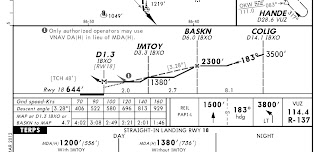
Since the approach isn't in the FMS, it doesn't know where the point "1" in the shaded circle is; therefore, it can't calculate a flight path angle. But wait, there's more. Because of terrain on final, there is a stepdown fix (IMTOY) about halfway down final, then seemingly a further descent to the MDA.
In my airplane (MD11), I would set the flight path angle (FPA) to −3.3 degrees 0.2 miles before BASKN (lead distance to give the autopilot time to catch up), then set 1380' in the altitude window. If we don't have the runway by 1600' above mean sea level (MSL, read from the altimeter, which is 740' above field elevation), then there is no point going any lower, even though it is procedurally allowed. 1380' MSL is the minimum altitude at IMTOY, and since by company policy the autopilot must be engaged on an NPA until able to proceed visually, the airplane will start increasing pitch attitude at 1580' in order to level off at 1380'. Since this takes the airplane above the desired glidepath, the presence of IMTOY effectively destabilizes the approach. So, practically speaking, if the runway isn't in sight 0.6 miles before IMTOY, then a missed approach is the only alternative. What this points out, among other things, is that how to fly an NPA depends greatly upon what kind of airplane you are in. A light civil with an approach speed of 80 knots can do things that an airliner with an approach speed of 140 knots can't manage.
AFAIK, the FMS in the A300 does not have the ability to command an FPA; however, the approach chart has a table to allow quickly determining the equivalent descent rate based upon ground speed. For UPS 1354 it would have been −813 feet per minute; the crew could have rounded to −800 fpm and accepted the 20-ish foot error that would have accumulated by IMTOY, or done a "dive and drive", the term for using a higher descent rate to reach MDA, then leveling off and driving to the next altitude restriction. I don't know what UPS does; my company gives pilots the option.

So, clearly, there is much more involved with this approach than for a precision approach, both in analysis and execution. But despite the fact that pilots flying the big-iron almost never do non-database NPAs, it does happen, so all of this has to be well within our skill set.
It is at this point where I start speculating about how the mishap report will finally read. Up until a week ago, it would have gone like this: Primary cause — failure to acquire and follow the VGSI. With the runway in sight, the PF disengaged the autopilot at BASKN in order to fly a visual approach. However, because of the failure to acquire the VGSI, in combination with black hole visual illusions, the pilot flew well below the required glide slope, causing a CFIT mishap. Secondary cause — the PM also failed to acquire the VGSI, but nonetheless allowed the PF to descend below MDA in violation of approach requirements.
Pretty straightforward. I can see the PF getting wrapped up enough in the task to succumb to channelized attention. That the PM just rode it in is tougher to explain. But it wouldn't be the first time.
So what happened last week? The NTSB released some preliminary information, including that the autopilot was engaged until the flight data recording ended, and there were ground proximity warning system (GPWS) generated "sink rate" calls about five seconds prior to the first impact with the trees.
Wait. What? Whatthewhat?
The autopilot was engaged? With MDA as the target altitude, the autopilot would have leveled off at 370' above the point of impact. Since the airplane was apparently operating completely normally, then there are only two possibilities: the target altitude was miss set well below MDA, or erroneously set above 2300' (the altitude at BASKN where the final approach starts).
To anyone who is still awake, even those who are not pilots, the latter alternative must seem surpassing odd. Yet this is where I'm placing my speculamatation bet. When flying big-iron, nearly 100% of the instrument approaches not in the simulator are precision approaches. Once commencing the final approach, the crew will set the missed approach altitude, in this case 3800', as the target altitude.
The other perplexing element of all this is the role of the enhanced GPWS (EGPWS). GPWS uses the radar altimeter to determine the airplane's height above the ground, then combines configuration, airspeed, and other parameters to determine if the sink rate is risking imprudence. Roughly speaking, the closer to the ground, the sooner the GPWS will throw a "sink rate" call.
The obvious shortcoming is that the system can't deal with significant terrain approaching the airport. EGPWS incorporates GPS position and a terrain database built specifically for each surveyed runway. Nearly all runways long enough for an A300 are in the database. The EGPWS builds a terrain clearance floor (TCF) that gets thicker with distance from the runway. The idea is that a normal approach will always be above the buffer, so any penetration of it, or a too rapid approach to it, will generate a "Too Low — Terrain" call. The inner boundary of the TCF starts somewhere between 0.3 and 1.5 nautical miles from the runway. Somehow the EGPWS failed to trigger at all, possibly because the TCF started at the far end of that range. The GPWS, fooled by terrain, gave a warning that, with only about 6 seconds to the first impact, was nearly too late. An immediate go around would probably have saved the day, but the crew didn't react to the warning. At Northwest, a "sink rate" call at night or in the weather required an immediate go around. At my current company, the flight operations manual makes no specific mention. However, the stabilized approach criteria exclude a sink rate high enough to generate the warning, so the reaction should be the same.
So where does this leave my speculations? The brute fact of the impact point means that this is fundamentally pilot error. The approach requires the VGSI to descend below the minimum altitude for the approach; obviously, neither pilot had acquired it. Terrain played a factor, because it likely delayed warnings from the ground prox system. The night/black hole effects contributed, but that is the sort of situation which pilots should know to treat with a great deal of respect.
The crew may have been complacent; the cockpit voice recorder will demonstrate that one way or the other. At my company, the minimum runway length for an A300 is 5,700 feet. That is less than the 7,000 for BHM 18/36, but not by much. Had I been operating into a field just barely longer than the minimum, via a NPA at night, and only 45 minutes en route, I would have had this thing fully sussed before heading for the jet, and with the mental go-around switch armed and put on a hair trigger. The results suggest they viewed this as another ho-hum approach, even though it wasn't.
Had the airplane gone no lower than the MDA, even if it violated the crossing restriction at IMTOY, we would have never heard about UPS 1354. This is, to me, the single biggest mystery about this mishap: the PF must have set the wrong altitude — it happens occasionally — and the PM must not have caught it. That happens occasionally, too. Occasionally times occasionally equals damn rarely, but not, unfortunately, never.
With the advent of GPS, there are a lot more waypoints for FMSs to store. Consequently, flight departments have started deleting some approaches from aircraft databases. Ordinarily, no one is going to choose the BHM LOC RWY18, because it is a short runway and there are ILSs to the long runway, so this is probably one that ended up in the bit bucket. Because neither the LOC or GPS approach wasn't in the database, the crew couldn't use the airplane's ability to generate a flight path angle to a point on glideslope and only a mile from the runway.
As is always the case in mishaps like this, a whole lot of dominoes had to line up just right: the desired runway had to be closed, it had to be night, the approach had to go over a black hole, the best option had to have been deleted from the database, the terrain had to be just so, the approach flown required a lot of fiddling with the target altitude, both crew members had to not notice the miss-set altitude, both crew members had to channelize attention on a runway so seductively visible, yet somehow miss the four red youregonnadie lights.
And a couple asides.
The approach chart contains an error that, if spotted, would have prevented the crew from flying the approach.
Obviously, no one who is not an instrument rated pilot is going to find it. Unfortunately, I must admit that this pilot didn't, despite looking at the chart many times while writing this, spotted it, either. While doing research for this post (i.e., what should be a part of journalism, but rarely is), I visited some pilot forums.
Which is when I got yet another lesson in how subtle human factors considerations can be. In the fourth box from the top there are some notes, one of which says "When VGSI inop, procedure not authorized at night." That I saw.
Before commencing an approach, the pilots must ascertain whether the reported weather is above some minimum value. But that value depends upon the approach speed of the aircraft, and whether the airplane is capable of identifying IMTOY (if the localizer distance measuring is out of service, non-GPS airplanes cannot identify IMTOY). My airplane can identify IMTOY regardless. Because my airplane has a high final approach speed, it is in Category D. So I go to the bottom of the chart, and because that is what we Latin alphabet people do, read from the left until I get to the With IMTOY column, then look down to the block that includes Category D: the visibility must be better than 1⅝ miles. Since I have satisfied my search criteria, I'm done.
Wrong. Because I have gotten the answer to my question, I will not continue searching, and will not notice the column on the right hand side that explicitly states that this approach may not be flown at night. Period. In the aviation world, the most restrictive restriction wins. Therefore, strictly speaking, the crew were not allowed to request the approach. And, oh by the way, the dispatchers were not allowed to dispatch the flight to Birmingham at night because the weather didn't allow a visual approach, and approach control would not be allowed to clear them for an approach that isn't available in the first place. All of which means a lot of people missed this error.
Actually, the "Night — NA" is wrong. But in a realm that has to focus obsessively on detail and procedure, that isn't a call anyone gets to make; the "Night — NA" rules until the chart is corrected. The contradiction in the chart renders the approach unavailable, yet a lot of people — many times more than I listed above — all missed it. Why? Because it was hiding in plain sight. We read from right to left, and stop when we get the information we need. No one continued beyond the "Without IMTOY" column, because by then you are done.
So if the approach actually had a night prohibition (and there are some), it has to be in the leftmost column, not lurking out in front of God and everybody on the right. Alternatively, the restriction has to integrated with the visibility requirement, e.g. DAY/ 1⅝. Hanging the "Night — NA" off to the right is a human factors disaster. One of the outcomes to this mishap should be to fix every approach chart that has that restriction so that it isn't so diabolically invisible.
And finally, an observation that goes beyond this mishap. I fly with, oh, 30 different Captains a year. At my current company, over nearly seven years, that population of 200-ish Captains includes three women. The airplanes flying primarily domestically have a higher proportion of women, but it is still pretty small.
Depending upon what you want to consider a significant mishap, at my company roughly 40% have had a woman as part of the crew. Almost all of the serious US accidents in this decade have had a woman on the flight deck: Buffalo (FO, PM), the recent Southwest schlamozzle (Capt, PM then PF), and UPS 1354 (FO, PM). This isn't confined to the US, either. (I hadn't twigged this until reading a pilot forum on the Southwest nose gear collapse, when someone started listing the mishaps, both domestic and international.) Occam's razor insists on picking the simplest explanation, which is the tyranny of small numbers: any statistician could tell you that a coin could come up heads a half dozen times in a row. But at some point that explanation becomes a bit strained, and enquiring minds should look elsewhere.
Although I'm risking an extended stay in re-education camp, I would look to both affirmative action, and human dynamics: male display, and female deference.
Okay. Hit the post button, then run to the bunker with a month's worth of food, water, and underwear.
Over and out.
First Asiana 214, then Southwest 345, now UPS 1354. Three serious landing mishaps in quick succession. What's going on here — have pilots forgotten how to land?
While the accidents are superficially similar, they are actually significantly different. I have already speculated that Asiana was a glaring example of inadequate basic flying skills caused by excessive reliance on automation.
SWA 345, which thankfully didn't seriously hurt anyone, was the result of a snap decision by the Capt to salvage a landing when a missed approach was in order. The First Officer allowed a low altitude (approx 500') change in the winds from 11 kts on the tail to 10 knots on the nose to shift the aimpoint well down the runway, which would have caused a long touchdown (speculamatation, except for the winds). The Capt took control at 400' (fact), then readjusted the aimpoint; however, the adjustment required was quite large, particularly that close to the ground (speculamatation). The consequences were an unrecoverable high sink rate and nose first touchdown (fact). That is at least bad headwork, and possibly a sign of overall marginal piloting ability.
In contrast, UPS 1354 is far more complex. Ultimately, the cause of the mishap will be controlled flight into terrain, a sufficiently common cause of accidents that it has its own acronym: CFIT. In other words, due to a lack of situational awareness, the crew flew the airplane to a point that wasn't the runway. But there is probably a lot more to it than just that.
First, a quick summary of the UPS 1354 mishap sequence:
- The flight was a 45 minute leg from Louisville, KY to Birmingham, AL.
- Weather was above approach minimums — scattered clouds at 1100 feet, ceiling at 3500 feet, good visibility, and calm winds; it was still night.
- The primary instrument runway was out of service. The instrument approaches to the secondary runway are non-precision approaches (NPA) which means they only had horizontal guidance.
- The Captain was the pilot flying (PF), the First Officer Pilot Monitoring (PM). Both pilots were fully qualified in the A300.
- The flight was cleared for the Localizer approach to Rwy 18 (i.e., the final approach course is due south).
- The aircraft was fully configured and on speed.
- The aircraft impacted trees approximately a mile short of the runway, then the ground.
This is a much more complex accident chain than either Asiana or Southwest. It certainly involves human visual limitations. It might also involve one or more of channelized attention, proficiency, procedures, complacency, terrain, and flight management system (FMS) memory limitations.
During the day, gauging the proper glide path, while not a superhuman feat, is reasonably demanding: being more than a half degree above or below is significant. At night, all bets are off. The lack of depth cues at night turns what was already non-trivial into downright difficult. Making matters worse, the final approach was over sparsely lit terrain, creating what pilots call the "black hole" effect. This aggravates the already existing tendency to be low on final at night, making it even more likely that the deviation will not be detected, even up to the point of impact. Because the only available instrument approach did not have vertical guidance, it required far more respect than a precision approach, even with the available visual glide slope indicator (VGSI) system (the approach procedure is prohibited at night if the VGSI is inop). There was nothing inherently dangerous about the combination of weather, darkness, and a non-precision approach (NPA), but it did create a situation requiring more skill and preparation than a garden variety precision approach.
The next thing worth noting is that there were two available instrument approach procedures (IAPs), one relying upon a localizer (e.g., a ground based radio beacon for runway alignment and range), the other using GPS. This is the IAP for localizer approach to runway 18 at Birmingham (BHM LOC 18 -- click on the image to enlarge):

Often, the distinction has no difference. When an NPA is in the Flight Management System (FMS) database, GPS and LOC approaches are procedurally the same: once cleared for the approach and established on a segment of the procedure, the PF sets the minimum descent altitude (MDA) in the altitude command window. MDA is the lowest altitude the pilot may fly until the runway environment is in sight and the airplane is in a position to fly a stabilized approach to the touchdown zone. The airplane will fly the correct descent angle so as to reach the MDA at the correct point from which the pilot can manually fly the airplane to touchdown without any change to the descent rate other than that induced by changing winds.
Sometimes, though, there is a big difference. If the approach is not in the FMS database, which for reasons is likely the case here, then the airplane has no visual descent point on the MDA to fly to, whether using the localizer or GPS, then the difficulty factor increases. This is the profile view of the LOC RWY 18 approach to BHM:

Since the approach isn't in the FMS, it doesn't know where the point "1" in the shaded circle is; therefore, it can't calculate a flight path angle. But wait, there's more. Because of terrain on final, there is a stepdown fix (IMTOY) about halfway down final, then seemingly a further descent to the MDA.
In my airplane (MD11), I would set the flight path angle (FPA) to −3.3 degrees 0.2 miles before BASKN (lead distance to give the autopilot time to catch up), then set 1380' in the altitude window. If we don't have the runway by 1600' above mean sea level (MSL, read from the altimeter, which is 740' above field elevation), then there is no point going any lower, even though it is procedurally allowed. 1380' MSL is the minimum altitude at IMTOY, and since by company policy the autopilot must be engaged on an NPA until able to proceed visually, the airplane will start increasing pitch attitude at 1580' in order to level off at 1380'. Since this takes the airplane above the desired glidepath, the presence of IMTOY effectively destabilizes the approach. So, practically speaking, if the runway isn't in sight 0.6 miles before IMTOY, then a missed approach is the only alternative. What this points out, among other things, is that how to fly an NPA depends greatly upon what kind of airplane you are in. A light civil with an approach speed of 80 knots can do things that an airliner with an approach speed of 140 knots can't manage.
AFAIK, the FMS in the A300 does not have the ability to command an FPA; however, the approach chart has a table to allow quickly determining the equivalent descent rate based upon ground speed. For UPS 1354 it would have been −813 feet per minute; the crew could have rounded to −800 fpm and accepted the 20-ish foot error that would have accumulated by IMTOY, or done a "dive and drive", the term for using a higher descent rate to reach MDA, then leveling off and driving to the next altitude restriction. I don't know what UPS does; my company gives pilots the option.

So, clearly, there is much more involved with this approach than for a precision approach, both in analysis and execution. But despite the fact that pilots flying the big-iron almost never do non-database NPAs, it does happen, so all of this has to be well within our skill set.
It is at this point where I start speculating about how the mishap report will finally read. Up until a week ago, it would have gone like this: Primary cause — failure to acquire and follow the VGSI. With the runway in sight, the PF disengaged the autopilot at BASKN in order to fly a visual approach. However, because of the failure to acquire the VGSI, in combination with black hole visual illusions, the pilot flew well below the required glide slope, causing a CFIT mishap. Secondary cause — the PM also failed to acquire the VGSI, but nonetheless allowed the PF to descend below MDA in violation of approach requirements.
Pretty straightforward. I can see the PF getting wrapped up enough in the task to succumb to channelized attention. That the PM just rode it in is tougher to explain. But it wouldn't be the first time.
So what happened last week? The NTSB released some preliminary information, including that the autopilot was engaged until the flight data recording ended, and there were ground proximity warning system (GPWS) generated "sink rate" calls about five seconds prior to the first impact with the trees.
Wait. What? Whatthewhat?
The autopilot was engaged? With MDA as the target altitude, the autopilot would have leveled off at 370' above the point of impact. Since the airplane was apparently operating completely normally, then there are only two possibilities: the target altitude was miss set well below MDA, or erroneously set above 2300' (the altitude at BASKN where the final approach starts).
To anyone who is still awake, even those who are not pilots, the latter alternative must seem surpassing odd. Yet this is where I'm placing my speculamatation bet. When flying big-iron, nearly 100% of the instrument approaches not in the simulator are precision approaches. Once commencing the final approach, the crew will set the missed approach altitude, in this case 3800', as the target altitude.
The other perplexing element of all this is the role of the enhanced GPWS (EGPWS). GPWS uses the radar altimeter to determine the airplane's height above the ground, then combines configuration, airspeed, and other parameters to determine if the sink rate is risking imprudence. Roughly speaking, the closer to the ground, the sooner the GPWS will throw a "sink rate" call.
The obvious shortcoming is that the system can't deal with significant terrain approaching the airport. EGPWS incorporates GPS position and a terrain database built specifically for each surveyed runway. Nearly all runways long enough for an A300 are in the database. The EGPWS builds a terrain clearance floor (TCF) that gets thicker with distance from the runway. The idea is that a normal approach will always be above the buffer, so any penetration of it, or a too rapid approach to it, will generate a "Too Low — Terrain" call. The inner boundary of the TCF starts somewhere between 0.3 and 1.5 nautical miles from the runway. Somehow the EGPWS failed to trigger at all, possibly because the TCF started at the far end of that range. The GPWS, fooled by terrain, gave a warning that, with only about 6 seconds to the first impact, was nearly too late. An immediate go around would probably have saved the day, but the crew didn't react to the warning. At Northwest, a "sink rate" call at night or in the weather required an immediate go around. At my current company, the flight operations manual makes no specific mention. However, the stabilized approach criteria exclude a sink rate high enough to generate the warning, so the reaction should be the same.
So where does this leave my speculations? The brute fact of the impact point means that this is fundamentally pilot error. The approach requires the VGSI to descend below the minimum altitude for the approach; obviously, neither pilot had acquired it. Terrain played a factor, because it likely delayed warnings from the ground prox system. The night/black hole effects contributed, but that is the sort of situation which pilots should know to treat with a great deal of respect.
The crew may have been complacent; the cockpit voice recorder will demonstrate that one way or the other. At my company, the minimum runway length for an A300 is 5,700 feet. That is less than the 7,000 for BHM 18/36, but not by much. Had I been operating into a field just barely longer than the minimum, via a NPA at night, and only 45 minutes en route, I would have had this thing fully sussed before heading for the jet, and with the mental go-around switch armed and put on a hair trigger. The results suggest they viewed this as another ho-hum approach, even though it wasn't.
Had the airplane gone no lower than the MDA, even if it violated the crossing restriction at IMTOY, we would have never heard about UPS 1354. This is, to me, the single biggest mystery about this mishap: the PF must have set the wrong altitude — it happens occasionally — and the PM must not have caught it. That happens occasionally, too. Occasionally times occasionally equals damn rarely, but not, unfortunately, never.
With the advent of GPS, there are a lot more waypoints for FMSs to store. Consequently, flight departments have started deleting some approaches from aircraft databases. Ordinarily, no one is going to choose the BHM LOC RWY18, because it is a short runway and there are ILSs to the long runway, so this is probably one that ended up in the bit bucket. Because neither the LOC or GPS approach wasn't in the database, the crew couldn't use the airplane's ability to generate a flight path angle to a point on glideslope and only a mile from the runway.
As is always the case in mishaps like this, a whole lot of dominoes had to line up just right: the desired runway had to be closed, it had to be night, the approach had to go over a black hole, the best option had to have been deleted from the database, the terrain had to be just so, the approach flown required a lot of fiddling with the target altitude, both crew members had to not notice the miss-set altitude, both crew members had to channelize attention on a runway so seductively visible, yet somehow miss the four red youregonnadie lights.
And a couple asides.
The approach chart contains an error that, if spotted, would have prevented the crew from flying the approach.
Obviously, no one who is not an instrument rated pilot is going to find it. Unfortunately, I must admit that this pilot didn't, despite looking at the chart many times while writing this, spotted it, either. While doing research for this post (i.e., what should be a part of journalism, but rarely is), I visited some pilot forums.
Which is when I got yet another lesson in how subtle human factors considerations can be. In the fourth box from the top there are some notes, one of which says "When VGSI inop, procedure not authorized at night." That I saw.
Before commencing an approach, the pilots must ascertain whether the reported weather is above some minimum value. But that value depends upon the approach speed of the aircraft, and whether the airplane is capable of identifying IMTOY (if the localizer distance measuring is out of service, non-GPS airplanes cannot identify IMTOY). My airplane can identify IMTOY regardless. Because my airplane has a high final approach speed, it is in Category D. So I go to the bottom of the chart, and because that is what we Latin alphabet people do, read from the left until I get to the With IMTOY column, then look down to the block that includes Category D: the visibility must be better than 1⅝ miles. Since I have satisfied my search criteria, I'm done.
Wrong. Because I have gotten the answer to my question, I will not continue searching, and will not notice the column on the right hand side that explicitly states that this approach may not be flown at night. Period. In the aviation world, the most restrictive restriction wins. Therefore, strictly speaking, the crew were not allowed to request the approach. And, oh by the way, the dispatchers were not allowed to dispatch the flight to Birmingham at night because the weather didn't allow a visual approach, and approach control would not be allowed to clear them for an approach that isn't available in the first place. All of which means a lot of people missed this error.
Actually, the "Night — NA" is wrong. But in a realm that has to focus obsessively on detail and procedure, that isn't a call anyone gets to make; the "Night — NA" rules until the chart is corrected. The contradiction in the chart renders the approach unavailable, yet a lot of people — many times more than I listed above — all missed it. Why? Because it was hiding in plain sight. We read from right to left, and stop when we get the information we need. No one continued beyond the "Without IMTOY" column, because by then you are done.
So if the approach actually had a night prohibition (and there are some), it has to be in the leftmost column, not lurking out in front of God and everybody on the right. Alternatively, the restriction has to integrated with the visibility requirement, e.g. DAY/ 1⅝. Hanging the "Night — NA" off to the right is a human factors disaster. One of the outcomes to this mishap should be to fix every approach chart that has that restriction so that it isn't so diabolically invisible.
And finally, an observation that goes beyond this mishap. I fly with, oh, 30 different Captains a year. At my current company, over nearly seven years, that population of 200-ish Captains includes three women. The airplanes flying primarily domestically have a higher proportion of women, but it is still pretty small.
Depending upon what you want to consider a significant mishap, at my company roughly 40% have had a woman as part of the crew. Almost all of the serious US accidents in this decade have had a woman on the flight deck: Buffalo (FO, PM), the recent Southwest schlamozzle (Capt, PM then PF), and UPS 1354 (FO, PM). This isn't confined to the US, either. (I hadn't twigged this until reading a pilot forum on the Southwest nose gear collapse, when someone started listing the mishaps, both domestic and international.) Occam's razor insists on picking the simplest explanation, which is the tyranny of small numbers: any statistician could tell you that a coin could come up heads a half dozen times in a row. But at some point that explanation becomes a bit strained, and enquiring minds should look elsewhere.
Although I'm risking an extended stay in re-education camp, I would look to both affirmative action, and human dynamics: male display, and female deference.
Okay. Hit the post button, then run to the bunker with a month's worth of food, water, and underwear.
Over and out.
posted by Hey Skipper at 5:11 PM
8 comments


